The tell-tale heart

*No, not Edgar Allan Poe, yet.

You and your pupils 🙂

“Once upon a time, in the lost gardens of a virtuous land, there was an aspiring but naive teacher who started an educational blog. She was so enthusiastic about writing on that very teeny-tiny blog. Every day and night, she dreamed of what to write; she planned ceaselessly countless essays with titles yet nothing more. Alas, a wicked, atrocious, petrifying day had come. She dropped all hopes and dreams into a fathomless, putrid hole where never-ending, severe, heart-pounding, mind-numbing remorse roamed with terror and agony alongside…” 

You are all hooked on, aren’t you? It makes you wonder now what that terrible day was if she has overcome or not. It is not magic. It is the power of words, the power of storytelling. I could have bluntly just told you how lazy I was, but it would not have engaged you this much to this post. It would be yet another thing I wrote here. Because storytelling is not just randomly telling or talking about something. It requires imagination, immense description skills, and a little bit of acting.

Here is what I mean: 

Now, try re-reading the story by imagining that I am right in front of you, telling you the story of my laziness by using my gestures, my voice, and a little bit of drama. I am moving around. You are with me, sitting on your chairs or cushions, etc. Try feeling your presence. You are watching me, listening to me attentively. It does change the whole experience, doesn’t it? 

As we all know, storytelling has an impact on foreign and second language learners.  Many researchers and educators have published research papers and books on the benefits of using it in our classrooms. Even the acclaimed book series; “Resource books for teachers” by Alan Maley had a storytelling book with activities. However, how much of this knowledge do we apply to our day-to-day teaching? When we use storytelling as a tool, how much of it is storytelling? Is it just read, listen and do worksheets? More importantly, as educators, are we aware of the difference between reading a story and telling a story?

I decided to write a post in two parts on this topic and my ultimate observation on storytelling, Denmark, and its Friskoles.

From my mouth to your ears

It shouldn’t be shocking that storytelling is not only part of our lessons, but also our everyday life since we all (incl. the whole world) started to preserve and communicate our cultures through the oral tradition or oral storytelling. Before we wrote, we spoke. It functioned to entertain, to educate. Socrates taught his pupils, such as Plato, with storytelling, not just with heated discussions or debates on forums. Plato, who must have been influenced by his mentor, actually gave quite a huge importance to education and in his Socratic dialogue Republic, he mentioned stories to educate mind and character which were more paramount than educating the physical body: 

“What kind of education shall we give them then? We shall find it difficult to improve on the time-honored distinction between the physical training we give to the body and the education we give to the mind and character.

True.

And we shall begin by educating mind and character, shall we not?

Of course.

In this education you would include stories, would you not?

Yes.”

–Republic: Book II, Plato 

Nevertheless, we always forget that storytelling is not just stories, but songs, poems, epics, etc. It is limitless. As we are more evolved and have other mediums of transferring information, we do not look at storytelling or the oral tradition as we used to. It is simply fantasies, and that is exactly when we start to lose the essence of reality in storytelling. Particularly, when it comes to our lessons, our storytelling is not that authentic as it is in our life. I am not implying that everything can be told for the sake of storytelling, not to forget, our purpose is not just storytelling, and of course, there should be a good and beneficial selection, effective planning, and a purpose but we can at least make our stories less fabricated, superficial and dull.

For the past 8 months, I have been in a very different school in Denmark. They have in fact, a unique methodology and approach when it comes to teaching. The method is based on the teachings of two sweet and old Danish guys, Grundtvig- Kold. In another post, I will talk about these Dane Platos and their methodology, one thing that I want to mention though, is how they relate storytelling with their approach:

“Since Christen Kold began to use it in his pedagogical work, the story has had a special place in the Grundtvig-Kold schools. Kold discovered that through storytelling, he could teach children much more in certain school subjects than through ordinary book teaching. But for Kold, the narrative became not just a pedagogical method in line with other methods. It contains under the right conditions in his view some dimensions that ordinary teaching does not. And the right conditions are partly the teacher’s commitment to the content of the story and partly the idea that the purpose of the story is not only to achieve a certain school knowledge but even more to become wiser about what human life is and what difficulties and joys there are. It is living the life here and now. When it is understood in this way, teachers and students are equal in their approach to storytelling – and therefore storytelling is not only a pedagogical method but also a way of being together. A great way to create mutual understanding and community.”

—Source: Fortælling –http://grundtvig-koldsk-skole.dk/leksikon/fortaelling/

You may think that “Yes, in theory, that sounds nice and *ahem* éducatif. But you cannot just tell stories all the time. There are things to do; homework to check, revisions before exams, etc.” True, but that is why we plan our lessons. Believe me, a revision with storytelling would make much more impact on just us, constantly explaining stuff, and asking them to do the next question. Especially in a language classroom, we expect them to use the language exceptionally in written and *wait-for-it* in oral. Besides, the storyteller does not always need to be the teacher. Our students can become one as well.

It is a continuation of oral tradition. It is a natural and unique human trait. So, we are back to basics. Our ancestors knew none another way than storytelling to educate. In this chaotic era, storytelling is still a way to document. We reminisced a lot on storytelling, and we are almost reaching the destination point. In the second part of this post, we will continue with storytelling and our classes.

Thank you for reading and hanging in there.

K.

More on Storytelling

https://www.nationalgeographic.org/article/storytelling-and-cultural-traditions/

https://study.com/academy/lesson/oral-tradition-of-storytelling-definition-history-examples.html

http://www.virtualmuseum.ca/Exhibitions/Holman/english/storytelling/index.php3

https://owlcation.com/humanities/Oral-Storytelling-an-Ancient-Myth-and-a-Narrative-Poem

https://www.philosophytalk.org/blog/evolution-storytelling

https://thestorytellers.com/plato-on-storytelling/

https://www.scu.edu/character/resources/education-in-platos-republic/

PS: I have even found a Masterclass on storytelling, if you are interested in that, here is the link:

https://www.masterclass.com/classes/levar-burton-teaches-the-power-of-storytelling/chapters/the-importance-of-oral-storytelling#

Another PS: I have just realized, I had another post on storytelling a couple of years ago. At the time, I mainly focused more on digital storytelling, and it was part of my assignment. The reason I emphasize the assignment part is I re-read it and didn’t like it at all. I missed the whole point of storytelling.

Back and There Again!

Such a good title after the last post and yes i may have been under the influence of “Tolkien” as i’ve seen the latest film on him and rewatching the LOTR series. Anyway, I welcome both you and I.

This blog has been left in the dark for a while so I need to turn on the lights, sorry and be careful while reading. YES! Let me start!

I wanted to start focusing on the blog again and i’ve already planned two posts these past months BUT I was being lazy and i was trying to find a job. I will publish those posts soon enough, however I didn’t want to leave the blog with the last post so I decided to write an “update post” and talk about how and towards which direction this blog will be shaped.

No more just an ELT teacher blog

As you know, I started this blog when I was a preservice teacher and the main focus of this blog was the technology in ELT classes. Although this was for a course I had I liked writing and developing ideas about the technology and English. I will still continue to post the things i find interesting and useful but I also want to share my experiences about being a preservice teacher. That’s why, i will have a section about this topic to help other preservice teachers.

Another thing i want to post on this blog is the educational philosophy. I believe that every teacher has a philosophy on teaching and education. I also would like to discuss more about the educational system around the world. Our approaches to the system and governments’ perception of education etc.

Last but not least, i will write about the language itself. Of course, I’m not going to talk about what is language, why we need it etc. as they have been discussed a lot but i will take a different route about the language. I want to share my language adventure and the attitudes towards the FLs and people’s perception of them.

Vous ne pouvez pas oublier le Français

C’est-à-dire, I will also create something on this blog that i’ve had at the back of my head since i started this blog. I will also post in French all the things i mentioned above and maybe slightly different things as well. You may jump into a pool full of ELT blogs but you have to dive deeper for French ones. I really like French and I really want to make a room in this blog for it. It will be good to discuss French Language Teaching, learning French and the approaches, the attitudes towards it and i will again share my experience as a french preservice teacher and compare these two experiences. Je ne sais pas ce que vous pouvez attendre mais on vera ensemble.

I’m quite excited about how this blog will turn out to be. I hope for the best and I will try my best. Please bear with me and be with me when all these things above happens!

Thanks,

Bilbo Baggins ✨

Illustration by unfortuantely i couldn’t find it sorry

Reading made easier!

Hello my fellow friends!

The Internet is growing day by day and the new information keeps entering the web. As there are a lot of information, it becomes harder to follow and harder to stay updated. It consumes a lot of time to visit our favourite sites one by one to keep ourselves informed. We need to keep the necessary information in one place . Therefore, we can actually use RSS Feeds Readers.

At the beginning of Instructional Technologies & Material Design course, before we created our blogs, we talked about RSS Feeds,how to use them and why it is essential to use. We started to use RSS Feed readers throughout the academic year and as a task, we were assigned to share our experiences about RSS Feeds Readers. Before i tell you about my experience with RSS feeds Reader and the blogs that i follow, i would like to talk about RSS Feed.

What is RSS Feed?

RSS (Rich Site Summary) is a format for delivering regularly changing web content. Many news-related sites, weblogs and other online publishers syndicate their content as an RSS Feed to whoever wants it. It is easy to use and it solves the problem for people who regularly use the web.

What is this problem and how RSS Feed can solve this?

As I mentioned above, for people who use the web all the time,it is difficult to follow so many blogs and websites. RSS Feed allows them to easily stay informed by retrieving the latest content from the sites they are interested in. They save time by not needing to visit each site individually. Moreover, they ensure their privacy, by not joining every site’s email newsletter.

How can we use RSS Feed?

It is very simple to use. You can use web-based readers such as Feedly, Bloglines, Flipboard or Pocket. If you don’t prefer a web-based reader, you can find other platforms. You can choose from numerous RSS Feed Reader programs such as FeedReader, AmphetaDesk or Feed Demon and download them.

RSS Feed Readers and I

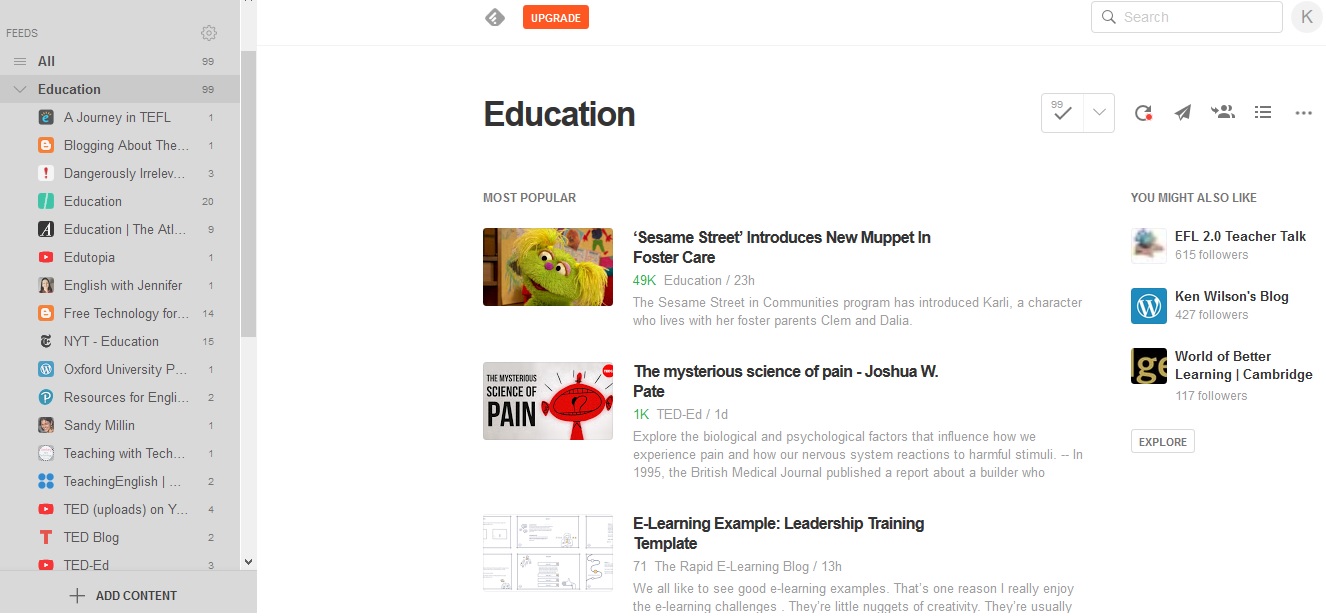
I chose a web-based reader as i didn’t want to download a program on my computer . I think that web-based ones are a lot quicker than the program ones. You can add your web-based reader in your bookmark and with just one-click, you can follow and read your favourite news and blogs. Thus, Pocket is very suitable if you prefer this type of reader as it has an extension for the web browsers. Before this assignment i used to use Flipboard and Pocket unconsciously which means that i didn’t know that i was using an RSS Feed reader. But, this time i wanted to try something else and use the RSS Feed with its full potential, i wanted to follow more education-oriented blogs so i chose Feedly and i was really impressed by its simple interface. The site is very easy to use and you can collect the sites you follow under a category.

A screenshot from my Feedly Account

I mostly follow educational content in Feedly and one of my favourite blogs is Free Technology for Teachers. I am more aware of the use of technology in ESL/EFL classes thanks to our course and I’m trying to find information as much as possible, from integration of technology to technological tools. The blog suggests various of activities with technological tools and how can Ss and Ts can use them. In addition, in this blog you can also see some alternatives for certain features of a technological tool if they are removed.

A screenshot from the feed of Free Technology for Teachers Blog

I do believe that every ELT teacher can benefit from this blog as its content isn’t only limited to activities with technology but so many review of technological tools, how to use them, how to solve issues related to the tools etc. We’re not technology experts and sometimes certain tools are too complicated to use , this blog facilitates them. The tips and suggestions are efficient as well. If you’re an ELT teacher or an EFL/ESL student, follow this blog and I’m sure you will enjoy it.

To sum up, using RSS Feed Reader is helpful in so many ways. As you’ve seen, it is very easy to keep track of the content from your favourite sites. I really do enjoy using Feedly on a daily basis and i feel like I’m reading more thanks to Feedly. I absolutely suggest everyone to try RSS Feed Readers. Trust me, you won’t regret it!

Thanks,

K.

Storytelling at its best…

Hello my fellow friends!

Do you listen to your grandpa enthusiastically when he starts telling you all his youth stories or you pretend to like it while counting the minutes? If your answer is yes to the first question, congratulations you’re an amazing listener. Don’t forget to thank your grandfathers for their interesting, creative storytelling skill.

Storytelling is a creative way to breath life into written works and the good news is grandpas ARE NOT the only ones who can tell amazing stories. Students and teachers can tell a lot of creative stories in ESL/EFL classrooms.

Why should we use storytelling?

The answer is simple. Storytelling,in fact is quite popular. So many youtubers have storytelling videos and “Draw My life” was actually a digital storytelling trend. Moreover, learners can tell their original stories and share this in a very vivid, fun way  with their peers. Storytelling will let them improve not only their writing skills but also their pronunciation as well. They will develop their speaking abilities and will be able to talk freely.

Why Digital though?

Back to grandpas. Some of us enjoy listening to their stories but unfortunately some of us lose interest listening to them. Have you ever asked yourself “why”? Is it because of their old age? NO! The reason is, we find it boring. Not the stories. The way of telling. We don’t want our students to get bored while telling stories so teachers and students should make these stories as attractive, as effective as possible by providing audios, videos, images, posters etc. related to them. They can even draw or make animations! They can use various tools to make their stories digital from online tools to movie making programs.

Our Digital Storytelling Experience

My friend Murat and I tried digital storytelling for our course to experience it and show you how you ,as teachers or students, or grandparents 🙂 can use digital storytelling. We’ve talked about our friendship, we made a video with our photos as slides. We used “iMovie” to make our video but you can find many alternatives for yourself and students. It was nice to tell our story of friendship and how we perceive friendship. Digital storytelling is actually something quite powerful if you can carry your message in an effective way. You can watch our video here and check out Murat’s blog as well. We’ll appreciate it.I hope you like it!

Thanks

K.

Wikibooks

Hello everyone!

I’m back with another post. I know what you’re thinking, and yes you’re right, I’m pretty quick. Jokes aside, this week our assignment in Instructional technologies and material design was to create a wiki page with a review of a book that we read.

I wanted to write a review on Yukio Mishima’s story called “The Sailor who Fell from Grace with the Sea.” It was a book that i had quality time with and writing a review on it was also a different experience. The review made me think one more time on the book and i realize now how deep the book was .

I hope you like it as well and start reading the book influenced by my wiki entry.

Thanks for reading!

K.

Illustration by: Annya Marttinen

A Full of Mystery Podcast

Hello everyone!

It has been a week since i posted on this blog. Today i’m going to post something that i had fun while creating.

As you may know, “A linguaphile’s Notes” was created as part of an assignment for “Instructional technologies and material design” lesson. Another task we had, was to create a podcast. I love listening to podcast and this time i was the storyteller, not the listener.

I wasn’t alone though. I’ve created the story and the podcast with my friend Murat. Don’t forget to check on him as well!

Without any further due, enjoy listening the podcast.

Thanks for listening!

https://vocaroo.com/i/s1nOR9vJH6qb

P.S: Keep in mind that i’m an amateur ☺️

P.S: Let me know your thoughts on the ending! What could “the thing” be?

K

Illustration: Myeong Minho